Showing posts with label numeracy. Show all posts

Monday, 29 March 2021

Noggle in Class

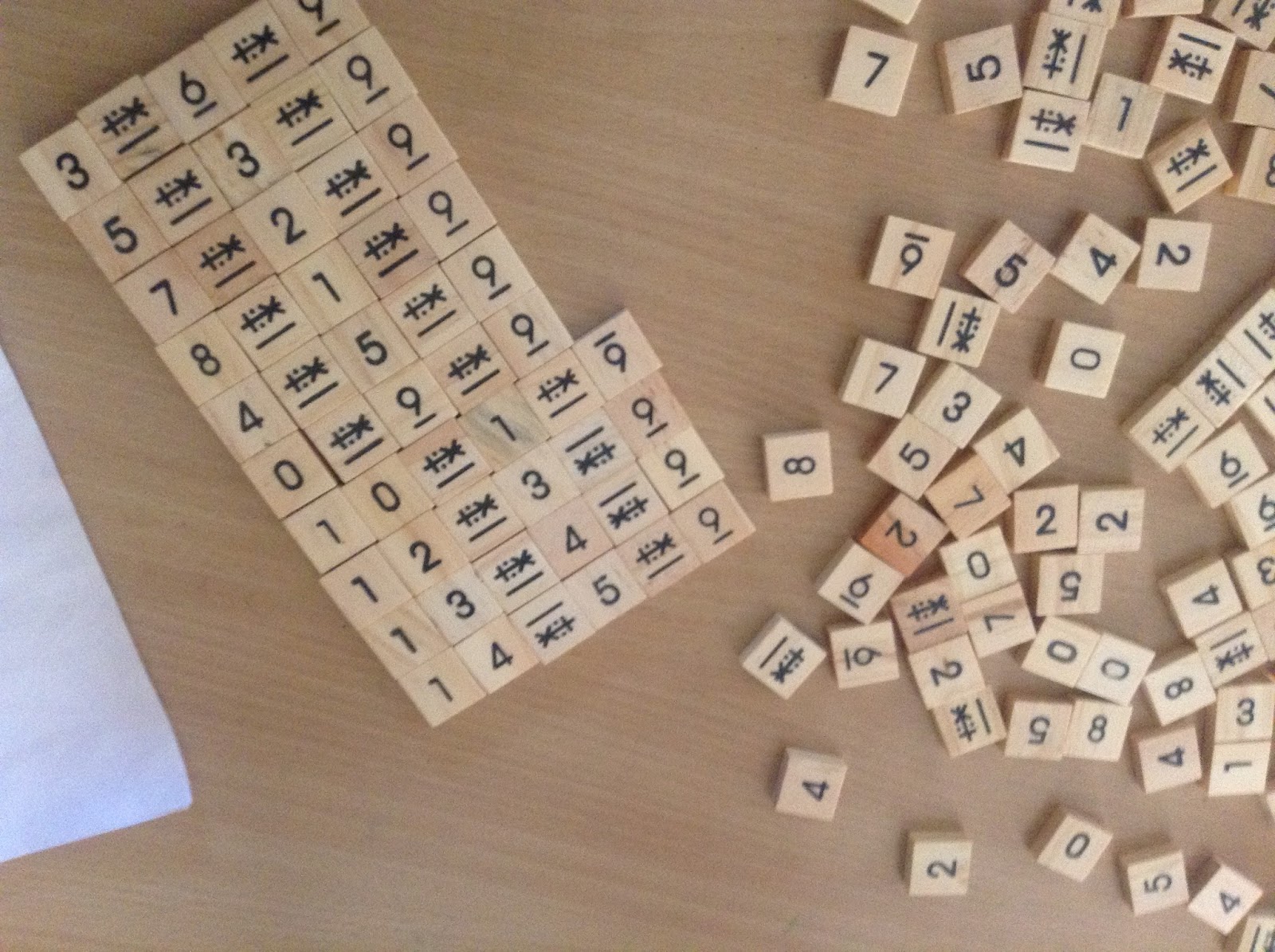
During the recent spell of 'Remote Learning', we were copied into a Tweet about "Noggle". Now we'd used 'Boggle' many-a-time, but not 'Noggle'. 

So, we looked at the information and gave it a go in one of our Google Meet sessions. We used the same layout as Lydia shared as the grid must be formed in a way that has mathematically correct calculations within it. 


We shared the above example with our class; showing a correct calculation and one that is incorrect. 

Our template can be found here.

Feedback from the children was positive and it lead to some great discussions. Going forward, we'll use it again. We may also get children to form their own grids too.

But, not this... 


We hope that's useful.


Wednesday, 30 December 2020

Connect 4 with Multiples

Earlier this year, we came across a blog post by Joe Schwartz entitled, 'I Like This Game Because You Have to Think Hard.'

In his blog post, he gave students a blank 100/120 grid for them to fill in trying to get 4 in a row. We saw the benefits of this activity, but currently working in Upper Key Stage Two, our pupils are pretty proficient with numbers between 0 and 100. So, we adapted the idea to make it about times table facts. 

1. Give the children a blank 12 x 12 grid of squares between two.
2. Ensure each child has a different coloured pen/pencil.
3. Children fill in facts on the grid, taking it in turns and trying to get four in a row horizontally or vertically. 
4. Depending on competence, children could have a times table grid on hand to enable them to check each others facts.


Enjoy!

Monday, 18 February 2019

Place Value and Receipts

As it's the Half Term break, my family and I took in a spot of lunch out earlier today. We were in a well known pub chain that have an app that allows orders to be made from the table...


A receipt we received, contained various numbers. All the numbers need to be read in Key Stage Two. Grab a load of receipts. Can the children in Year Four/Five read all the numbers on them?


Thursday, 31 January 2019

Vocabulary of Testing

Here's an idea from a colleague...

We do tests (not the official ones) to find out what children do/don't know, to give them practice of what a test is like and to teach test technique.

Good practice is to review the test with the pupils. What did they get right? What did they get wrong? Why?


Something we've recently learned is to ask the children for 'the words they did not understand'. Then, spend some time defining these words and then display them for all to see. Can't do the test if you don't understand the vocabulary...

Thursday, 29 November 2018

#Taskmaster - Estimate of Perimeter in...

Calculating perimeter can be a bit, er, repetitive.

Estimating can be a bit, er, repetitive.


So, you've been studying perimeter. You've measured, you've done 2(A+B), the trundle wheels have been out, you've costed a new fence for the school field and more...

You've tried and tried to convince your class of the virtues of estimating, but they think you're just balmy.

Well, we like this task!

In the task the contestants have to estimate the perimeter of the caravan in baked beans. So, perimeter of the field in beans, the perimeter of the school hall in paper clips, the perimeter of a maths book in dice and so on...

Same learning, same objectives, but in a different way. Mix things up and get 'em thinking! Let us know how y'all get on...

Sunday, 10 June 2018

Sporting Number Bonds

Last month, I was at a football match. The team I support were winning, for a change. As a result, I was clock watching for most of the second half. As time went on, I realised that my Number Bonds to 90 are pretty good.

Too often in school, we focus on Number Bonds to 10 and to 100. This is all good and well, but it's not enough. The children need to know their Number Bonds WITHIN 100. This then aids their addition and subtraction greatly. They need to know all 288 X and ÷ facts, and in the same way, they need to know these sum/difference facts within 100. For example, 5 and what make 13? 15 add 7 is? 23 added to 19? 44 subtract 17?

Here's an idea. 
Like I was, use the scenario of a sporting event to help:
Football: Number Bonds to 45/90
Basketball: Four 12 minute quarters
Cricket: Number Bonds to 6 (overs), 40/45/50 (game length)
Netball: 60 minutes, divided into 15 minute quarters
Ice Hockey: 60 minutes, divided into 20 minute thirds
Rugby Union: Number bonds to 40/80 

Saturday, 10 March 2018

Part Part Whole, Bar Model & Perimeter

Earlier this year, we were calculating perimeter of compound shapes with some missing measurements. Some children were struggling to work out which measurements were missing. 

So, we took to using the bar model to offer some support.


1. Count the sides of the shape
2. Colour horizontal sides one colour and vertical sides another colour
3. Identify which sides have an unknown length
4. Use 'Part Part Whole' bar model (one for horizontal and one for vertical) to help find missing lengths
4a. The bar models can also be colour coded the same as the sides
5. Check the number of lengths found matches number of sides and looks sensible 
6. Add them up...


It worked well for us. Of course, as always with the bar model, it will help work towards an answer, but not give an answer. 


Friday, 14 July 2017

Times Table (Ball Pit) Relay


After seeing something on Facebook, I did a times table relay with my class. On Twitter, Mr Dyson saw it and liked it. He challenged one of his teachers to 'do better'. That set me thinking!
And, today this is what we did...


I filled two recycle bins with ball pit balls;

Outside, I stood the sticks against a wall;


I put the Velcro numbers for a times table in each of the ball pits;

I then got the class, in turn, to run and collect a number, work out the times table and add it in the correct place on the stick. 


It. Was. Great!

Wednesday, 28 June 2017

Numenko for Maths

Earlier this year I came across Numenko one day on Twitter. You know, things just pop up and you click on them! So, I got in contact with Tom about packs for schools, but initially just decided to buy a set for me to use at home - my money, my game. :-) I fancied getting a game as I really enjoy Bananagrams and rather enjoy maths, so this looked great to me. I played at home and enjoyed it and I took my pack into school and found it useful...

Image credit: numenko.com


The game is good. It gets children doing maths, thinking, playing. So, that was good.


But, it's more than that! Above is algebra: I asked two pupils to create calculations with a :-) (freechoice) tile in them and then get their partner to work them out. can you?


Above and below, I asked two children to make as many calculations as they could that were equal to 9. Not all their calculations were correct and it raised some interesting discussion points.


The key is a multichoice. It's rather useful for discussing maths, making calculations, looking at patterns and raising discussions.


On his site, Tom has a number of free resources you can make use of.


I've found it really useful! You may do too. It's reasonably priced, and there's discount on offer for multiple purchases. If you try something out, let us, and Tom know what you've been up to. 


Friday, 16 June 2017

Times Table Relay

A little while ago we saw this video on Facebook:


Today, we gave it a go with our Year Five Class:


It was good:

- times tables
- team work
- critical thinking
- proof reading
- correcting other's work
- fun in the sun
- #math

Just another way to cover times tables that doesn't involve sitting at desks! Thanks to AnAppleForTheTeacher for sharing.

Sunday, 14 May 2017

Count von Count Place Value


Each day, or a couple of times a day, the count Tweets a number. Stick it on your board in your classroom:
 - can the children write it in numbers;

- what are its factors? Is it prime?;

- what's half of it? Double it;

- and so on...

Sunday, 30 April 2017

What Can I Do With My Abacus?

Previously, I successfully asked for some help in making use of the counting stick(s) I have in my classroom. I now make much better use of them. In addition, the crowdsourced document is still there for others to use too. Now, another thing I have in my classroom is my large abacus. I use it a fair amount, but am sure I can use it more and better...


Saturday, 18 June 2016

Musical Notation and Fractions

While planning a unit of work about fractions recently, a colleague (musical one) suggested using musical notation as a way of introducing fractions.

Four beats in a bar: this can be achieved in many many ways! 


A bit of a reminder / teaching about musical notation and off we went...


And then, the children had a go themselves:


The resources were all made using Printable Paper.


Tuesday, 8 March 2016

Impossible Darts Checkouts

Recently, I was watching a game of darts on the television. I don't watch or play much darts. The commentator mentioned something I'd not realised before. The player at the oche was on a total of 165, resulting in the commentator saying, "That's unlucky, 165 is one of the numbers that can't be made with a three-dart checkout." I immediately thought about how I could use this in a maths investigation. 


With a bit of research, I found this list of possible darts checkouts. And, I made the following resource to explain the investigation. Today, some of my Year Five children successfully completed the investigation and found it to be an 'interesting challenge'.

Wednesday, 9 December 2015

Calculation Races

Earlier this week, my class and I were undertaking a Number Talk. The question we were using was '19 X 24'. I hoped many children (mixed ability Year Five) would use a mental method or jottings (partitioning, rounding & adjusting and so on). 

However, over 90% of the class used a grid method or expanded column multiplication. Nothing wrong with that, except the focus we'd been having on mental methods and not always defaulting to a written method. We listened to how children had arrived at their answers and then discussed which were the most efficient. As a class, we then solved both 19 X 28 and 19 X 35 using rounding (20 X 28) and partitioning (10 X 35 added to 9 X 35) to remind them of the available less formal / mental / jotting methods available to them.


In order to win over the remaining doubters I still had in the class, I set the children a challenge. They'd solve a question using only mental methods, while I tired to answer it as a written method on the classroom whiteboard. Although I wanted to prove the mental method was quickest, I still tried really (really, really) hard to do my method quicker than the class. However, I 'lost' all three times (19 X 56, 19 X 45 & 29 X 34). I'd only got beyond setting up the method and doing the first part of the calculation. Class. Won. Over.


Will be doing more of it...

Wednesday, 11 March 2015

Me and My Counting Stick!


Well, how far I've come in a year!


5th March 2014, our staff meeting was to paint a counting stick. I had no idea what to do with it! This document (still open for edits) helped and the stick is now TWO sticks. They have their own place on the wall when not in use. 


Take a look at the crowdsourced document. Take some ideas from it and add some of your own if you have any. For me, it's gone from a painted piece of wood to an invaluable teaching too.

Monday, 7 July 2014

Looking for Sport's nth Term

I noticed that in the 2014 FIFA World Cup there are 32 participating nations and 64 matches. That's half participants to matches. 1:2 if you like. I noticed that as a possible pattern and wondered if it'd continue for a competition of 16 teams and therefore 32 matches. However, I didn't investigate. I'm going to get my class to...


Feel free to edit and adapt for your own class.

Saturday, 26 April 2014

Averaging Speed in Maths

Driving along, observing the speed limit and I entered a section of road covered by average speed cameras. I understand how these work and therefore know a driver should drive at a constant speed, at or under the speed limit, in order to avoid encountering a conviction. However, I observed a young lady speeding in between cameras and then slowing for each one. She clearly did not understand the term 'average'. This lead me to think about how 'average' could be taught using these cameras as a real life context.

I have two possible methods for carrying out this investigation:

One: Using the formula for calculating speed: Speed = Distance ÷ Time. Give the children a set of data. The data being that for time taken for drivers to travel the distance between cameras. The data can be put into the formula and then the children work out which motorists are within the limit and those who are not.

Image credit: www.walesonline.co.uk

Two: Giving the children the driver's speed in between each camera on a road and then the children calculate an average of those speeds. Again, from this the children work out which motorists are within the limit and those who are not.

The first idea is more in line with how the system actually works. However, the second would work better in a primary classroom for calculating averages. We've made a resource to accompany the latter.

Also: See Stuart's very useful and helpful suggestions below

Update: February 23, 2015


Thursday, 10 April 2014

Television - Beaming Ideas into your Livingroom!

"Don't watch the TV, it'll make your eyes square!"

"Sitting there all day will do you no good."

Indeed those are good points. Although, the first may not be scientifically accurate. We blogged a while ago about using an idea from a BBC show and we're confident most classes have had a go at the Countdown numbers or letters game.

Recently, we've made use of some ideas from School of Hard Sums. This was aided by some excellent resources from Stuart:


This made us thinks a little more. How about a classroom activity using Blankety Blank, Pointless, Eggheads Catchphrase and more...

Give it a go and as always. Let us know how you get on.