Saturday, 30 January 2016

Our Other Clock

We've shared previously the clock display that we both have on the wall in our classrooms. That clock is designed to share and remind children about some maths facts and vocabulary in an interesting way.


Last week, we realised that we've not written about what's above. Eight years ago (yes that long), Liam got given a new clock for his classroom wall. Upon receiving it, he realised that the plastic front could easily (reasonably easily) removed. So, he removed it and added some reminders about telling the time to the clock face. More information cloud be added. Different information could be added. Maybe different clocks in different places in the school having different information on them? It's a quick, easy (reasonably) and low-cost way of sharing time vocabulary.

Friday, 29 January 2016

TMBett16 Presentation

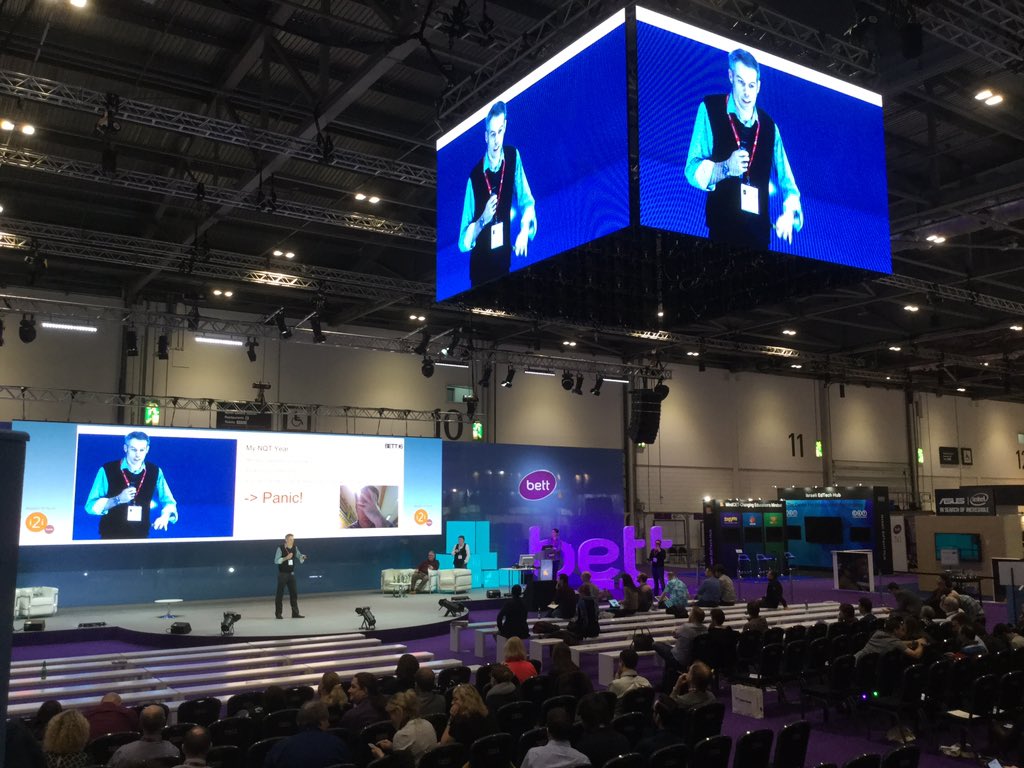
We've attended the Bett Show in some way for almost ten years. In addition, we've been able to attend the Friday evening TeachMeet for each of the last four years. We always come away from both buzzing, revitalised and full of new ideas.

Image credit: Martin B

This year, Liam decided to put himself down to present at the TeachMeet, and sure enough (after spending all day telling anyone who'd listen that he hoped his name wouldn't come up) the random name chooser fell - late in the evening - on '@ThisIsLiamM'. Liam presented about ideas previously shared on this blog and elsewhere. His slides can be found below, along with other relevant links.


Friday, 18 December 2015

#LikeAGirl Assembly

In the past, we've used videos in assemblies. In the main, these have been courtesy of Assembly Tube (and some we've made ourselves too). If you've not already checked out that resource, we suggest you take a look. One of our favourites from Assembly Tube is The Impossible Dream assembly.

At the start of this month, our vice principal shared the following videos with us:


With these videos, and some we added, we lead an excellent assembly with Years Five and Six. 

At the start, we showed the introduction of the first video, which showed people running in a silly way when asked to 'run like a girl'. This got a giggle from the mixed-gender audience and then we cut straight to this:


Chrissie Wellington being a real inspiration for us given her amazing achievements and, despite these, she is still relatively less well-known (we are always eager to do some Chrissie Wellington plugging). We discussed what an amazing athlete she is.

Then, because we are actually boys and feel that it is just as important that we get rid of stereotyping boys, we showed an extract from this video demonstrating Mad Chadd and his stunning dancing:


Rather sneakily we added this, in part, because we are both teaching dance next term and it allows us to demonstrate that it is not alright to say that dancing is "only for girls."

Moving on, we discussed how pernicious the phrase "like a girl" has become, both as an insult and, more worryingly, as a normal everyday comment. We also talked about how important it was to avoid other 'isms' through stereotyping and from this had a general discussion about moving forward with doing what people want.


Personally, we felt the most important part of the assembly came at the end: we discussed not letting others limit us or even limiting ourselves because of generalities and stereotypes. We ended by asking the children to ask a simple question if they are told they are not allowed to do something because they are a boy or a girl: why not?


Thursday, 17 December 2015

Word Class (Parts of Speech) Paper Chains

After our recent lesson using emojis to cover word classes, we were thinking about something a little more festive.*


We wrote five sentences, printed them on strips of paper, cut them up and asked children to recreate the sentences as paper chains. Each word class was printed on a different colour so that the children could identify the classes before and after making the sentences**. With the sentences we made, the capitalised words at the start of the sentences, commas and full stops were included on the strips of paper to get the children to think about how that impacted on where in the sentence the word would be placed. Our sentences can be found here.

**The word 'flies' is included as a 'subject'. With some children, an interesting discussion was held about why this word was not included as a 'verb'.


As it turned out, not all children made the original sentences that we had. Not all worked perfectly, as some had not considered tense and plural/singular before constructing the sentence. However, again a good discussion point. 

*Paper chains are not just for Christmas.

Tuesday, 15 December 2015

More Dice for Writing Exciting Sentences.

We are now trying the next step in our use of dice to support children in their use of Alan Peat 'Exciting Sentences'.

With the Year Six class we work with, we are giving the children, who have all been taught different sentence types over the last three years, a blank cube net as might be found here. The children, who are writing mystery narratives, are going to choose the most relevant and useful sentence types for their piece of writing, The challenge will be to take two dice and merge the two different sentence types into one wonderful sentence of complexity and detail (instead of appsmashing; sentencesmashing).

Whilst we love the way 'exciting sentences' serves as a toolbox for equipping children with different ways of adding sentence structures and punctuation, the ultimate aim is for children to develop a proper understanding of how those sentence structures and different pieces of punctuation work. Then we want them to effectively and appropriately 'break the rules' in order to make their writing more effective.


The purpose of this intermediate stage is to get the children to take a proactive role in choosing which sentence types work best for the text type they are writing and, more importantly, how they go beyond their basic use in making them more effective. For those writers who are confident, we now want to teach them to take risks with their writing and start deliberately breaking rules, from a basis of knowledge, in order to engage the reader.

The children found that some sentences worked more effectively than others. For example an 'if, if, if, then' sentence worked well with 'simile' sentences. It made them think even harder about the effect the words were having on the reader especially when the sentences went wrong. It also demonstrated those children who were learning the sentence types parrot fashion and needed some grammar and punctuation intervention as well as those who had a deeper understanding.

To get started with the 'exciting sentence' types, buy the book here.

Monday, 14 December 2015

Word Classes (Parts of Speech) & Emoji

At the start of December, I shared a lesson I'd carried out with my class utilising the Emoji Keyboard on iPad devices. I've recently done something very similar, but this time with the focus being on word classes (parts of speech).

The emoji symbols give the children a prompt for what they could include in the sentence and next to the emoji is an indication of how that emoji is linked to a word class. In the main, the sentences created were correct. Where errors occurred (adjective / adverb confusion or the wrong noun being used as the subject), it provided the opportunity to address misconceptions. Once children had used my prompts, they were then able to create their own. They had to follow the same process though: create the prompt first and then write the sentences. 

It was interesting to see how children could take the same prompt and create so many different sentences from it.


Sunday, 13 December 2015

Maths and Mariokart

One of the best video games in recent times (and much further back) is the consistently excellent Mariokart available on the various Nintendo devices.
We recently looked at how we can make use of this video game to do some 'real-life' context problem solving.
To start we asked the question: how fast is Mario driving?
Mathematically, this led to an excellent discussion on what information we needed to know in order to answer the question. We talked about units of measurement, distance and (inevitably from a  scientific point of view) the different variables we needed to control. After this discussion, we were able to move forward with carrying out some experimental races.
In order to keep things accurate we used the time trial race (which took out the danger of flying mushrooms or turning into a rocket); avoided the use of speed up pads and completed the race several times.
 Practical maths part one was finding an average from the times we got after the first round of races. Then we needed to find out the distance of the track we were racing on. Initially, we could not find the distance so we fired off a message to Nintendo and they, brilliantly for the class, replied and directed us to a different wiki site to the one we had visited in our early research. Now, armed with our times and distances, the class was able to try and find the speed average speed that Mario was travelling at around the track.
The kids were very excited to take part in this activity and eagerly engaged with the problem. All children were able to take part in the initial maths discussion and, working in mixed ability groups, were able to come up with a solution.
Next we are going to work on coming with comparative speeds for the different vehicles in Mariokart.