Tuesday, 17 March 2015

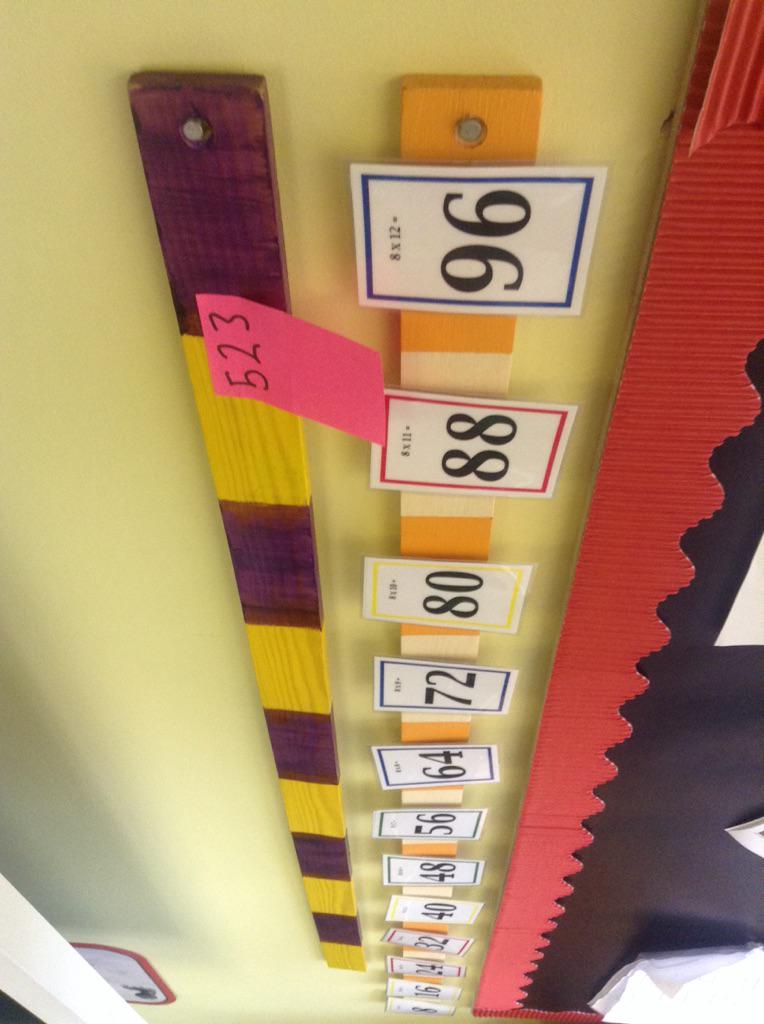
More Times Table Ideas

On Monday 16th March 2015, our school held an internal TeachMeet as our staff meeting. Here's one of the presentations we made as part of that...


Update 26th March 2015:

Thursday, 12 March 2015

Spoof in Maths

In my younger days, I loved a game of Spoof. I thought I was quite good at it. I enjoyed the challenge of trying to outwit others at a game that involved elements of chance, estimation and prediction.


Earlier this week, I was looking for a new starter for my maths lesson. Spoof came to mind, I grabbed some counters and decided to give it a go. 

I introduced the game (explaining the rules and giving a demonstration) and off the children went. Lots off excitement, success, mathematical thinking and reasoning. 

Anyone unfamiliar with the game, here are the rules:

- each player has three objects that can be held in their hand;

- everyone chooses to put 0, 1, 2 or 3 objects in their hand and holds it out;

- in turn, each player predicts how many objects are in all the hands;

- the winner is the one with the correct answer.


In a game of three players, the total could be between 0 and 9. To give an answer, the player must use times table and counting knowledge, estimation and prediction skills, while knowing what's in their hand and taking into consideration what other players have said.

Note: I did not give the game a name as I'm aware of it being, "typically played as a gambling game, often in bars and pubs".

Wednesday, 11 March 2015

Me and My Counting Stick!


Well, how far I've come in a year!


5th March 2014, our staff meeting was to paint a counting stick. I had no idea what to do with it! This document (still open for edits) helped and the stick is now TWO sticks. They have their own place on the wall when not in use. 


Take a look at the crowdsourced document. Take some ideas from it and add some of your own if you have any. For me, it's gone from a painted piece of wood to an invaluable teaching too.

Thursday, 12 February 2015

Re-Blog: "From Me To You"

Recently, our Dropbox has been getting more and more visitors. This makes us happy - we like the idea of others benefiting from our online sharing. In part, this has been helped by UKEdChat starting to share some of what's in there.


On Staffrm, Liam explained why we set the shared Dropbox folder up:

"I make resources and I use them with my class. I'm paid to do that. However, if I put those resources somewhere that others can make use of them, other teachers and children can benefit from what I created. Why don't I charge for them?"

Sunday, 8 February 2015

Estimation Challenge

At the end of January, I attended a day's maths training. It was good, I got lots of good ideas. The one that stood out was this one:

I sat next to a lady, whose name I didn't find out, let alone what school she was from (if I find out, an update will be added). She gave me the following idea.


Ask the children to fill pots and containers at home with 'stuff'. For example, paper clips, pebbles, marbles and so on. Then, each week, put one of these on display and invite the rest of the class to estimate the number of items in the container. Ensure the child setting the challenge know the answer. 


Sunday, 1 February 2015

Give Them The Answer

When completing calculations in maths, I've sometimes found that a child has gone through a whole lesson and some how managed to get all or most of the work wrong and not been picked up by a peer or an adult. While on one level this is not a huge problem, as it can be followed up later, it's not ideal.

I'd been looking for a way to avoid this and here's what I came up with...

Give the children the answers.

A) Get the children to start and after a few minutes show the answers to question one for all levels of differentiation, a few minutes after that the next ones and so on...

B) Get the children to start and then put the the answers to the first three questions only, as a guide. Children complete the rest of the work without know the answers.

C) Give the children the questions, with the answers already filled in.

By no means do I use this all the time. It's a idea, to use now and again. Does it work? Yes. The children need to understand that maths (or any work) is not always about getting the right answer. Mistakes are ok. In a lesson, children are learning, trying out and developing methods. Not doing a 'getting ten right answers' exercise. Children need to be confident in trying out their methods or jottings, comparing their answer to the one given and then, if there are any errors, they need to look for what went wrong, seek help from a peer or talk to an adult. 

Give it go. Not every lesson though.