Showing posts with label GPS. Show all posts

Saturday, 13 January 2018

Dialogue and Breaking the Fourth Wall

If you're looking for a way to teach punctuating dialogue, it's hard to beat Lee's "Teaching Direct Speech Punctuation using the iPhone text messaging!", which he published nearly five (FIVE) years ago.

Recently, I've been reading books in the following series to both my own children and my class. As someone reading a book out loud, the thing I like it is the way the books talk to their audience and invite them into the narrative.


The reason they're appearing in this post is that they're written as direct speech, with the speech in speech bubbles.

Ideas:
- children look at page or pages in a book and convert the speech bubble(s) into written, punctuated dialogue.

- children create a dialogue between themselves and the book. The books get the reader to think or intimate a response. These could be written down.

- children could write the narrative of the story. Still writing dialogue, but adding actions and descriptions too.

Just a few ideas to get you started...

Tuesday, 14 November 2017

Preposition in the Classroom

Heard of Elf on a shelf, right? So, here's something inspired by it...


Print and laminate the word 'preposition'. Each morning, put it on, under, behind, inside something and the class need to find it, and then describe where the word is, using a preposition...


On the window, under the chair, next to the board...

Friday, 28 July 2017

Edit Your Friend's Facebook Posts

Some of my friends on Facebook and contacts on Twitter write beautifully and accurately, others (like me) have the off (:-)) typo here and there, while others just write with errors all over the place (your/you're - grrr).


This is a post by a friend of mine on his Facebook page. I took a screen capture and asked my class to correct it. We did it as an Exit Ticket activity.

So, spot an awful social media update, copy it, anonymise it, and give it to your class... 

Wednesday, 31 August 2016

Your Red

At the time of writing, the video below is one of Tesco's current television advertisements. Firstly, watch it before you read on.


Did you hear what we heard? Will your children in your class? - you're / your

So, Tesco ended their advert with a homophone play on words. Here are some suggestions for classroom use:

- Play the advert and ask the children if they spotted anything.

- Ask them to write the script for the final 10 seconds. Do they use the correct homophone?

- Can they think of another homophone that could have closed this advert?

- Can they create another, similar advert, that uses a homophone to sell something?

- Can the children use this advert as an aide-mémoire to remember your/you're?

If you have any of your own suggestions, please feel free to leave a comment.

Sunday, 17 July 2016

Taskmaster: Prepositional Phrases

A third addition to our ideas for the classroom that have come from the television program 'Taskmaster'

This time, linked to English, and grammar in particular. Watch the video below:


The task set was along the lines of, "Place the gym balls on the yoga mat that's on top of the hill. While most contestants carried the balls up the hill to the mat, Richard Osman went up, brought the mat down and then place the balls onto it: balls on the mat that (was) on top of this hill. Room for interpretation in the prepositional phrase? Greg Davies thought so. 

Can you set you children a similar task and look for scope within the prepositional phrases involved to carry out the task in 'their own way'?

Monday, 16 May 2016

Lynne Truss' Books for Punctuation

I can remember when 'Eats, Shoots & Leaves: The Zero Tolerance Approach to Punctuation' was first published. I was at university at the time and a house mate purchased it as a gift for his mother. I had a flick through and found some of the contents of interest. A few years later, and now teaching, I came across the 'child version' of the book. So, I made a purchase and often us the three child-friendly versions of the original in class. Although aimed at children, these books often act as an aide-mémoire for me too!


We've recently been looking at how commas can change the meaning of a sentence. 'Eats, Shoots & Leaves For Children: Why, Commas Really Do Make a Difference' is ideal for introducing this. After looking at the examples in the book and some of what's in the other two books pictured above, we had a go at writing some of our own:


Monday, 25 April 2016

That's Not My Homophone

We've got about fifteen of these books in our house. My daughter loves them. The images and tactile features of each page are great for engaging a toddler with reading.


What I've realised is that just about every page of the book covers 'that's', 'its' and 'too'. So, today I took in one of her books and projected it for the class to read. The vast majority of them recognised the book. We read it and discussed 'that's', 'its' and 'too' as we came to each one. My main teaching point was 'too'. I told the class to think of these books every time they write 'too' or 'its/it's'.


Friday, 15 April 2016

Fictional Animals and Determiners (A or An)

A couple of years ago, I went to see the comedian John Richardson in a tour called 'Nidiot'. He named his tour this as, when he called someone 'an idiot', he said it sounded like he'd said 'a nidiot'. Similarly, 'an onion' and 'a nonion'.
At the start of this year, I shared with my class the 'Alot' - it's been on my wall since. Whenever a child writes 'alot', we refer to it and we're all now writing 'a lot' (most of the time).
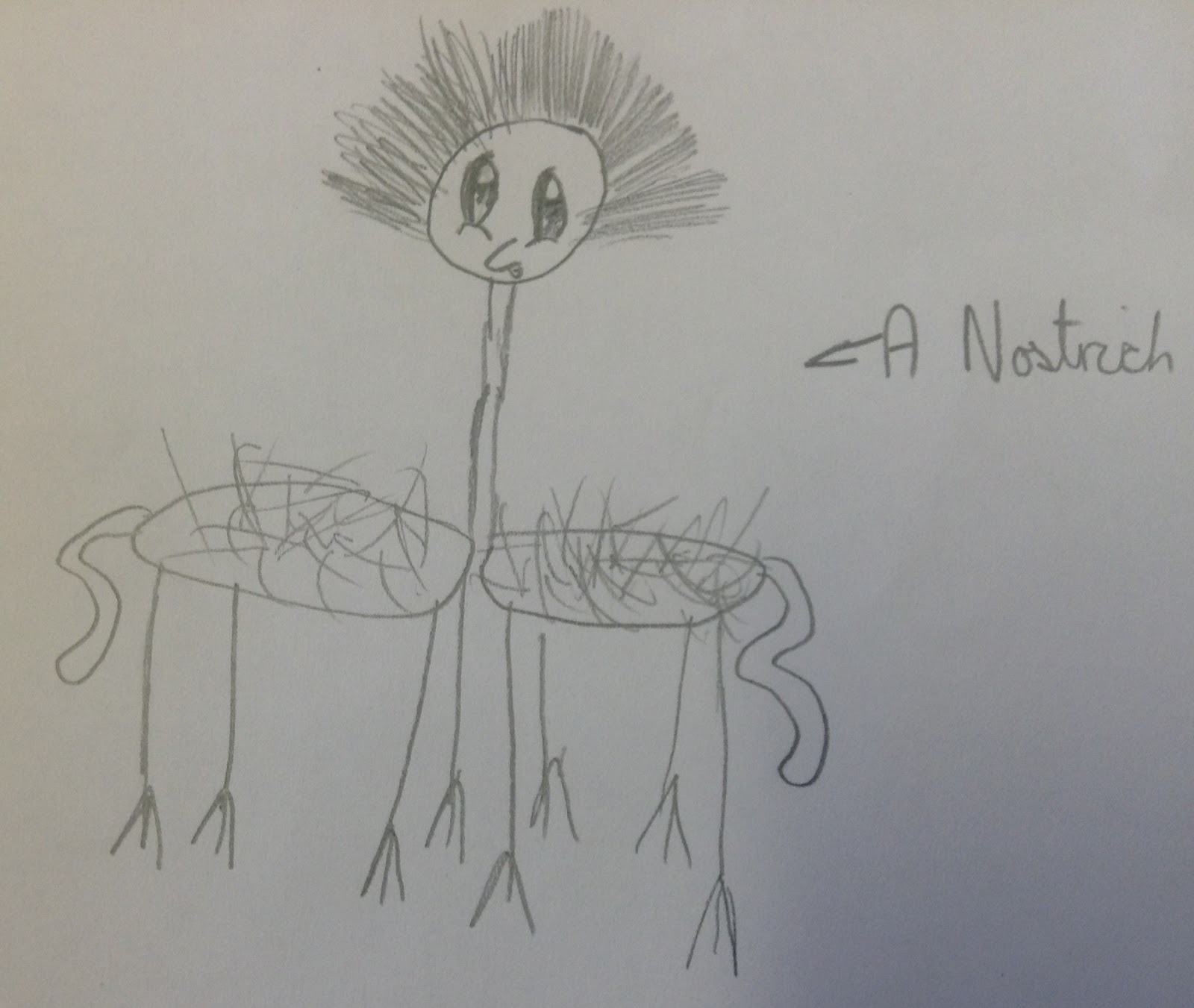
In this lesson, we had a go at creating our own fictional animals. Take an animal that begins with a vowel sound, separate and a and n in an and create a new animal starting with an n. Here's how the lesson went...
We started by looking at some alots. 'Alot of money', 'I like Christmas alot' and others. We found them amusing and talked about what they reminded us of. Next, we listed some determiners. From that list, we wrote out the three types of article (a/an/the). I then displayed a picture of an orange and an onion. I got the children to repeatedly say what they could see. Then, I wrote up 'a nonion' and 'a norange'. This time, I got the class to say these two phrases. Much amusement from the Year Fives about how much 'an orange' sound the same as 'a norange'. The children then created their own new fictional animals to remind us about the rules around articles.

Some of these are now on our Woking Wall, along with the Alot, as a reminder about articles. As part of the lesson, we also covered why it's 'an hour' as opposed to 'a hour' and listed some words that begin with a consonant letter, but a vowel sound. If any other classes create their own animals, we'd love to see them.

Update (30/01/2017): It's a real thing! Rebracketing.

Friday, 8 April 2016

WordsEye

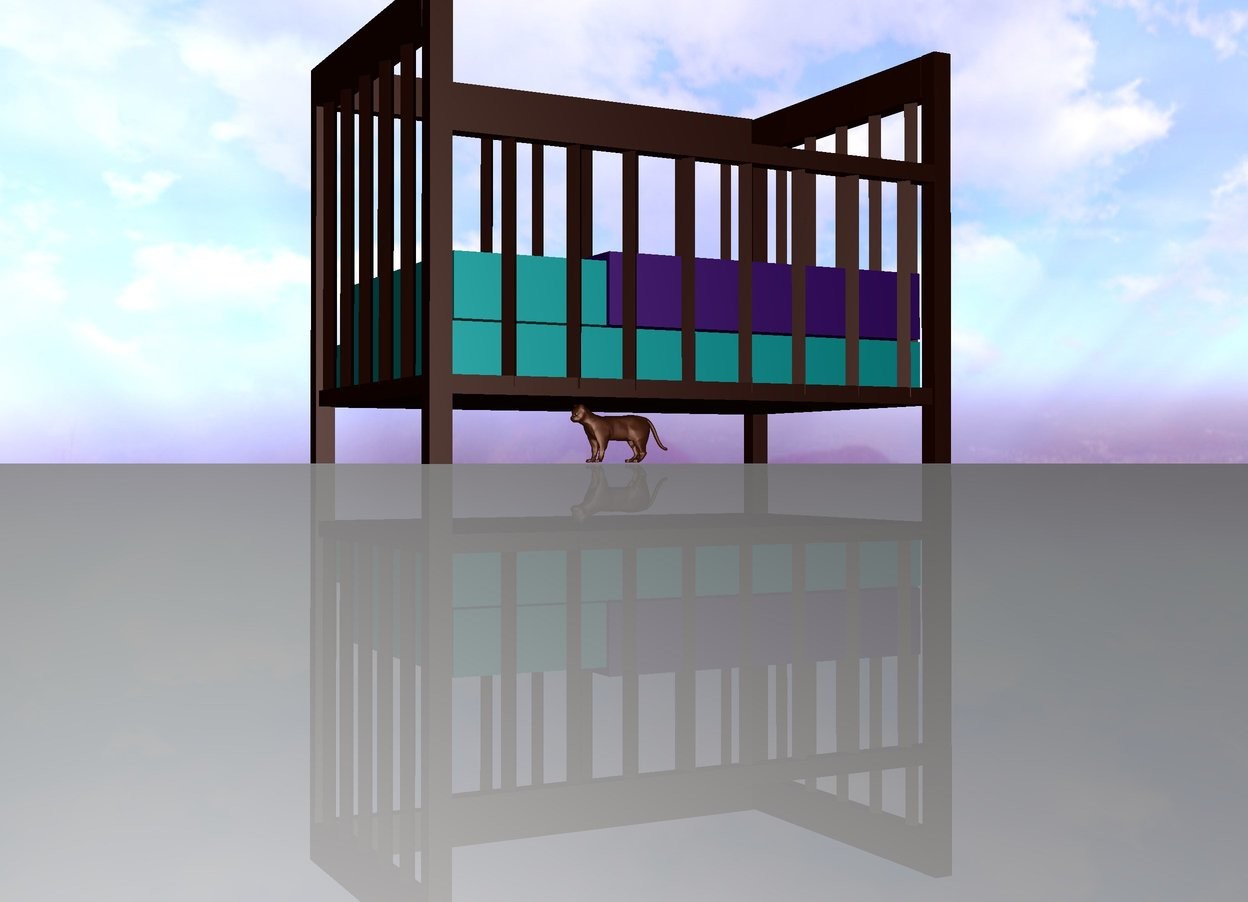
At the time of writing, WordsEye is currently in Beta. "WordsEye lets you type a picture! Create 3D scenes simply by describing them and share your creations with friends."


Type a sentence into WordsEye and it creates a picture of that sentence. The image above is based upon the sentence, "Cat under the large bed."

Current ideas for use of the pictures: prepositions, adjectives, determiners and story prompts.
Prepositions - display the picture and ask children to describe the relationship between the nouns pictured.

Adjectives - describe the picture to someone else.

Determiners - create a picture with a number of objects in and use determiners to pick out one or more of them.

Story prompt - create or use someone's picture and write a story based upon it.

We see this being used as a teacher's resource and not children. UPDATE: WordsEye contacted us to tell us about their "educationportal". Click here for details. Got some more ideas for uses? Let us know.

Saturday, 12 March 2016

Word Class (Parts of Speach) & Colours

As written about previously, we noticed some children really struggling to remember word classes and therefore not form sentences correctly or know how to improve and develop their sentence structures.
We wrote a sentence, in black text and uploaded it to Google Drive. The children then accessed that Google Doc and changed the colours of each word to show what they thought the word class was. Each child had their own copy of the sentence to work on. After the children had answered, the Doc was locked and the answers discussed.

Friday, 19 June 2015

Your Own Bank of GPS (SPaG) Resources

With a bit of inspiration from Stephen Lockyer, we've set off on a new venture. After reading this post by him, we wanted to find a website, Pinterest board or similar that had photographs with grammar errors on that could be used with Key Stage Two children. The reason we wanted a website with 'friendly' images on was so that it could be a go-to place either while planning or if something came up in a lesson. Everything there could be trusted to be classroom material. A web image search is often great, but can involve a lot of scrolling and sometimes things that shouldn't be shown in a classroom.

Because we often find it difficult to switch off from 'teacher mode', while out-and-about, we sometimes spot that companies have made errors on their signs (or intentionally made broken grammar rules as part of their branding). We have started to take photos of these and store them on Dropbox so that we (and others) can make use of them.

Here's one from a hospital toilet:

And one Tweeted to the council responsible for it:
After discussing the errors or branding, a company or person could be written to by a class or pupil to explain what's wrong. And, as the photo was taken by the teacher, we're able to explain its location and context. It may even be in a location familiar to the children.

Our images can be found here. Please feel free to use them.